


I sat through a short farm-stand clip of a grower selling the last of his cantaloupes off a trailer. Not a polished “5 tests” video. Just a guy who had a trailer that used to be piled full, now down to the last ones, asking customers the same question before he even let them grab a melon.
That question is the whole method.

First: when are you going to eat it?
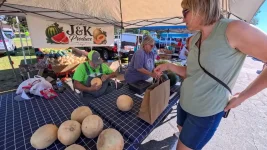
He asked twice:
“You want one to eat right away, or a day or two?”
That is not small talk. A melon that is ready tonight and a melon that will be ready Wednesday are not the same fruit. If you are going to a potluck in three days, you do not want the one that already thumps ripe. If you are cutting it when you get home, you do not want the firm one he would have you sit on the counter.
Tell the seller (or yourself, in the field) the timeline first. Then pick.
The stem is supposed to come off
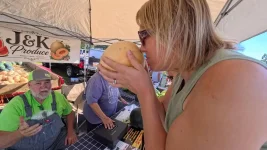
He said it straight: most of the time those stems are supposed to come off. He scratched at one while talking.
That is the old “full slip” test, just said like a person instead of an extension bulletin. When a muskmelon / American cantaloupe is actually finished on the vine, the plant forms a separation layer. The stem lets go and leaves a clean, slightly cupped scar — not a torn stub, not a knife-cut flat spot.

Clean indented scar, stem gone or barely hanging: vine decided it was done.
Green stem still glued on, or a ragged stub: it was pulled or clipped on the picker schedule, not the plant’s.
If you grow your own, do not wrestle it. If you are in a tug-of-war with the vine, leave it. Come back tomorrow.
The white spot and the stripes
He mentioned what everybody talks about — the pale spot and the striping — then immediately set it aside for what the farmer actually uses.
The pale patch is the ground spot (where the fruit sat on the soil). On watermelon that creamy-yellow field spot is a real ripeness cue. On cantaloupe it is weaker. Netting that is raised and even, and a background color that has gone from green toward creamy tan/gold, matters more than obsessing over one white patch.
Use the ground color as a first filter. Do not stop there.
The bongo test (this is the watermelon)

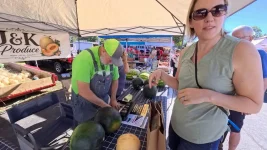
In the clip, after he talks about the white spot and the stripes, he stands up, takes a dark seedless watermelon, and holds it against his chest. Then he knocks it. That is the “bongo” method. It is not a cantaloupe trick. Cantaloupes in that video get the stem, the scratch, and the sniff. The drum is for the watermelon.
Why the chest
He does not thump it out in the air like a basketball. He parks it on his sternum so his body becomes the sounding board. You hear the note in your chest as much as in your ears. That is why he said “you know what a bongo sound is.” A ripe melon gives a low, hollow, resonant dum — like a small drum with a skin on it. An unripe one pings. Tight. Higher. More like knocking a green pumpkin.

Do it on two melons in the same pile. Your ear is junk until it has a comparison.
How to do it at a stand or in your own patch
What the sound is actually telling you
Inside a ripe watermelon the flesh has loosened off the rind a little and the cavity around the heart is developed. That air-and-flesh mix is what makes the low drum. An underripe melon is still packed tight; the tap stays high and short. An overripe one can sound dull too, but it will also feel soft at the blossom end and the rind will give. If it thuds and the skin is yielding under a thumb, leave it. You want firm rind, deep note.
Sugar does not increase after you pull a watermelon either. The thump is “is this one done,” not “will this one get sweeter on the porch.” Eat the bongo melon now. If you need one for Friday, pick a slightly tighter note and keep it whole at room temp a couple of days — it will not get sweeter, it will just sit.
Seedless vs seeded
He is working seedless fruit on that table. Same test. Seedless often sound a little less booming than an old-fashioned seeded Black Diamond because the interior is denser, so do not wait for a cannon. Compare two seedless of the same size from the same pile. The riper one is still the lower, more open note.
Put the two fruits back in their lanes
From this exact stand:

He was not giving a grocery-list of five internet tests. He was sorting a trailer of fruit for the person standing in front of him. Ask when you will eat it. Then either sniff the muskmelon or drum the watermelon on your chest.
That question is the whole method.
First: when are you going to eat it?
He asked twice:
“You want one to eat right away, or a day or two?”
That is not small talk. A melon that is ready tonight and a melon that will be ready Wednesday are not the same fruit. If you are going to a potluck in three days, you do not want the one that already thumps ripe. If you are cutting it when you get home, you do not want the firm one he would have you sit on the counter.
Tell the seller (or yourself, in the field) the timeline first. Then pick.
The stem is supposed to come off
He said it straight: most of the time those stems are supposed to come off. He scratched at one while talking.
That is the old “full slip” test, just said like a person instead of an extension bulletin. When a muskmelon / American cantaloupe is actually finished on the vine, the plant forms a separation layer. The stem lets go and leaves a clean, slightly cupped scar — not a torn stub, not a knife-cut flat spot.
Clean indented scar, stem gone or barely hanging: vine decided it was done.
Green stem still glued on, or a ragged stub: it was pulled or clipped on the picker schedule, not the plant’s.
If you grow your own, do not wrestle it. If you are in a tug-of-war with the vine, leave it. Come back tomorrow.
The white spot and the stripes
He mentioned what everybody talks about — the pale spot and the striping — then immediately set it aside for what the farmer actually uses.
The pale patch is the ground spot (where the fruit sat on the soil). On watermelon that creamy-yellow field spot is a real ripeness cue. On cantaloupe it is weaker. Netting that is raised and even, and a background color that has gone from green toward creamy tan/gold, matters more than obsessing over one white patch.
Use the ground color as a first filter. Do not stop there.
The bongo test (this is the watermelon)
In the clip, after he talks about the white spot and the stripes, he stands up, takes a dark seedless watermelon, and holds it against his chest. Then he knocks it. That is the “bongo” method. It is not a cantaloupe trick. Cantaloupes in that video get the stem, the scratch, and the sniff. The drum is for the watermelon.
Why the chest
He does not thump it out in the air like a basketball. He parks it on his sternum so his body becomes the sounding board. You hear the note in your chest as much as in your ears. That is why he said “you know what a bongo sound is.” A ripe melon gives a low, hollow, resonant dum — like a small drum with a skin on it. An unripe one pings. Tight. Higher. More like knocking a green pumpkin.
Do it on two melons in the same pile. Your ear is junk until it has a comparison.
How to do it at a stand or in your own patch
- Decide when you will cut it. Same rule as the cantaloupe: tonight, or later.
- Turn it over and look at the field spot — the pale patch that sat on the ground. Creamy yellow, not bone-white, not still green. That is the “white spot” he waved off as what everybody talks about. Use it. Do not stop there.
- Stripes on a striped variety should look faded and dull, not glossy and high-contrast. On a solid dark seedless like the ones on his table, you lean harder on the spot, the weight, and the thump.
- Heft it. Heavy for its size. A light one is pithy.
- Hold it against your chest. Knuckle-thump, not a slap. Listen for the bongo, not the box.
- A dried brown tendril next to the stem, if you grew it yourself, is the field confirmation. At a market you usually do not get that, which is why he sells the sound.
What the sound is actually telling you
Inside a ripe watermelon the flesh has loosened off the rind a little and the cavity around the heart is developed. That air-and-flesh mix is what makes the low drum. An underripe melon is still packed tight; the tap stays high and short. An overripe one can sound dull too, but it will also feel soft at the blossom end and the rind will give. If it thuds and the skin is yielding under a thumb, leave it. You want firm rind, deep note.
Sugar does not increase after you pull a watermelon either. The thump is “is this one done,” not “will this one get sweeter on the porch.” Eat the bongo melon now. If you need one for Friday, pick a slightly tighter note and keep it whole at room temp a couple of days — it will not get sweeter, it will just sit.
Seedless vs seeded
He is working seedless fruit on that table. Same test. Seedless often sound a little less booming than an old-fashioned seeded Black Diamond because the interior is denser, so do not wait for a cannon. Compare two seedless of the same size from the same pile. The riper one is still the lower, more open note.
Put the two fruits back in their lanes
From this exact stand:
- Cantaloupe: “Eat it tonight or in a day or two?” Stem should slip or scratch off. Smell the blossom end. Counter two or three days if it is not “super, super sweet” yet. $8 in the clip.
- Watermelon: White/yellow ground spot, faded stripes if it has them, heavy, then the chest bongo. That one is ready right now.
He was not giving a grocery-list of five internet tests. He was sorting a trailer of fruit for the person standing in front of him. Ask when you will eat it. Then either sniff the muskmelon or drum the watermelon on your chest.
Attachments

Last edited: